From Paper Records to Smart Traceability
October 30, 2026
Imagine a manufacturing company receiving hundreds of raw materials every day, processing them into finished products, transferring them between warehouses, and distributing them to multiple customers.
Now imagine that a customer reports a product defect or a food safety incident.
How long would it take the company to identify the affected batch, locate the remaining stock, determine which raw materials were used, and establish where the finished products were delivered?
For many manufacturers, this information still exists across paper records, Excel spreadsheets, barcode systems, and disconnected databases.
Traditional traceability can meet regulatory requirements when properly maintained. However, growing production volumes and increasingly complex supply chains make manual processes more difficult to manage.
RFID (Radio Frequency Identification) offers a way to automate product identification, connect physical movements with digital records, and improve visibility across manufacturing and distribution.
But where should a company begin? What improvements can it realistically expect? How far has Europe progressed with digitalization, and what role will Digital Product Passports play?
Traditional vs. Digital Traceability: What Changes with RFID?

Traditional traceability is generally based on recording product information at defined stages of production and distribution.
Employees register raw material deliveries, batch numbers, production dates, quantities, storage locations, and dispatch information using paper forms, spreadsheets, or software.
The system can be effective, but its reliability depends heavily on timely and accurate data entry.
RFID changes how identification data is captured.
An RFID tag contains a digital identifier that can be read through radio waves. When tagged products, cartons, or pallets pass compatible readers, the system can automatically record identification events.
If RFID is connected to enterprise resource planning (ERP), warehouse management (WMS), or manufacturing execution systems (MES), those events can be linked to production and inventory records.
Traditional traceability vs. RFID-enabled traceability

| Traditional traceability | RFID-enabled traceability |
|---|---|
| Often requires manual data entry or individual barcode scanning | Supports automated identification at designated reading points |
| Information may be distributed across multiple records | Can connect identification events in a centralized system |
| Inventory checks may require physical counting | Can accelerate inventory verification |
| Batch histories may take time to reconstruct | Can enable faster retrieval of connected batch records |
| Recording errors depend on manual processes | Reduces certain manual errors but introduces technical controls |
| Lower initial technology investment | Requires investment in infrastructure and integration |
Importantly, RFID is not the same as digital traceability. A company can achieve digital traceability using barcodes, QR codes, databases, and integrated software without RFID.
RFID is one technology that can improve how information is captured.
What can RFID improve inside a manufacturing facility?

Raw material receiving: RFID can identify incoming pallets or containers and associate them with purchase orders, suppliers, and receiving records.
Production and work-in-progress: Tagged containers, reusable bins, or work orders can be tracked between production stages. With appropriate integration, the system can support material genealogy and production status monitoring.
Warehouse management: Automated identification can help locate stock, verify transfers, and reduce discrepancies between physical inventory and system records.
Finished-product dispatch: RFID can support verification that the correct pallets or cartons are being shipped to the correct customer.
Quality assurance: Connected identification records can help quality teams locate products placed on hold, identify affected batches, and investigate nonconformities.
For food manufacturers, these improvements support the traceability processes required within HACCP-based food safety management systems.
However, RFID does not replace hazard analysis, microbiological testing, temperature monitoring, or quality inspections. Its contribution is primarily in identification, data capture, and information connectivity.
2.How to Implement RFID in Manufacturing: A Practical Step-by-Step Approach

A common implementation mistake is purchasing RFID hardware before identifying the operational problem it needs to solve.
A successful project should begin with process analysis and measurable objectives.
Step 1: Evaluate the existing traceability system
Map how materials and products move through the facility.
Identify the stages where information is recorded, transferred, verified, or lost.
Useful questions include:
- How long does a complete traceability exercise take?
- How frequently do inventory discrepancies occur?
- Which processes require repeated manual data entry?
- Can the company identify all affected products during a simulated recall?
- Are production, warehouse, and distribution records connected?
This assessment establishes the baseline against which improvements can be measured.
Step 2: Select a pilot process
RFID does not need to be introduced across the entire factory immediately.
A pilot project should focus on a clearly defined process where automation could deliver measurable benefits.
For example, a food manufacturer might begin with finished-product pallet identification between production and the warehouse.
The pilot could evaluate whether RFID reduces inventory-checking time, improves dispatch verification, or accelerates the identification of products on quality hold.
Step 3: Select appropriate RFID technology
The company must determine which objects will be tagged and how they will be identified.
This includes choosing suitable RFID tags, readers, antennas, and encoding standards.
In supply chain applications, RAIN RFID, which uses UHF technology, is widely used.
However, the manufacturing environment matters.
Liquids, metal containers, packaging materials, product density, and tag positioning can affect performance. Food manufacturers should test tags and readers under actual operating conditions before purchasing equipment at scale.
Step 4: Establish identification and data-management rules
The system must define how each product, batch, pallet, or reusable container will be identified.
GS1 standards, including identifiers such as GTIN and SSCC where appropriate, can support consistent identification across organizations.
RFID data should be linked to reliable master data, including product codes, batch numbers, quantities, and relevant production information.
Without accurate data, automation simply processes incorrect information faster.
Step 5: Integrate RFID with existing software
RFID becomes significantly more useful when connected to ERP, WMS, MES, or other operational platforms.
For example, a pallet identification event can update warehouse records, while dispatch events can be associated with customer orders.
Integration should also include exception handling. A missed read, duplicated event, damaged tag, or incorrectly assigned identifier must not silently create an inaccurate inventory record.
Step 6: Validate the system and train employees
Before full implementation, companies should test:
- Tag-reading performance and reliability.
- Accuracy of inventory and movement records.
- Integration with existing systems.
- Handling of missed or incorrect reads.
- User access and cybersecurity controls.
- System recovery and backup procedures.
Employees must understand how to use the system and what to do when an exception occurs.
Step 7: Measure performance and expand gradually
The company should compare pilot results with the original baseline.
Useful KPIs include inventory accuracy, time required for stock counts, dispatch errors, traceability retrieval time, and the cost per identified logistics unit.
Only after demonstrating practical value should the project expand to additional production lines, warehouses, or facilities.
The objective is not to automate everything immediately. It is to build a reliable system that can grow with the business.
3.How Far Has Europe Progressed? RFID Adoption and Manufacturing Digitalization Statistics

European businesses are investing in digital systems, but it is important to distinguish general digitalization from RFID-specific adoption.
There is no sufficiently current, comparable EU-wide statistic establishing how many manufacturers have completely replaced traditional traceability with RFID.
Historical Eurostat data provide some insight into earlier adoption. In January 2009, approximately 3% of EU27 enterprises used RFID technology. Among those RFID users, 29% reported applications involving supply-chain or inventory tracking. These figures covered several RFID applications, including access control, and should not be interpreted as the proportion of manufacturers with fully digital traceability.
A later study based on 2014 Eurostat data found an average RFID usage rate of approximately 12.2% across the manufacturing sectors of the countries included in its analysis. This was a historical cross-country average, not a current EU-wide manufacturing adoption rate.
More recent Eurostat data provide a clearer picture of broader business digitalization.
European business digitalization indicators
| Indicator | Reported result | Year |
|---|---|---|
| EU enterprises using RFID technology | 3% | 2009 |
| Average RFID usage in manufacturing across countries analyzed in a research study | 12.2% | 2014 |
| EU enterprises using ERP software | 46.45% | 2025 |
| EU manufacturing enterprises using ERP software | 57.62% | 2025 |
| EU enterprises using paid cloud computing services | 52.74% | 2025 |
Sources: Eurostat and research based on historical Eurostat RFID data. These indicators use different years, definitions, and populations and cannot be treated as a single RFID adoption trend.
The figures demonstrate that digital business infrastructure is increasingly common in Europe.
However, using ERP or cloud software does not necessarily mean that a company has implemented RFID or end-to-end digital traceability.
Why does this matter for manufacturers?
The growing use of integrated business software creates opportunities to connect inventory, production, quality, and distribution data.
RFID can complement these systems by improving the collection of physical product identification events.
For manufacturers exporting to international markets, this can support customer expectations regarding traceability, inventory accuracy, and information exchange.
Nevertheless, companies should assess technology based on their own operations rather than assuming that every competitor has already implemented RFID.
The relevant question is not how many businesses have purchased RFID tags, but how effectively digital identification is improving their operations.
4.Digital Product Passports: Which Manufacturing Sectors Will Be Affected?

One of the most important developments in European product information management is the Digital Product Passport (DPP).
A Digital Product Passport is a structured digital record containing information associated with a product, component, or material.
Depending on the applicable regulations, this information may include material composition, product origin, environmental characteristics, repairability, recycled content, and other compliance-related data.
The purpose is to make relevant product information more accessible to manufacturers, customers, regulators, repairers, and recyclers.
What is the difference between RFID and a Digital Product Passport?
RFID is a technology used to identify a physical object and capture its identifier.
A Digital Product Passport is a structured collection of information associated with a product.
They are not interchangeable.
RFID may help connect a physical product to its digital record, but a DPP can also be accessed using other data carriers, including QR codes.
Which industries should prepare?
The EU is introducing Digital Product Passport requirements progressively.
<text weight=”medium”>Key sectors include:</text>
| Manufacturing sector | DPP relevance |
|---|---|
| Batteries | Mandatory DPP requirements for certain battery categories begin on 18 February 2027 |
| Textiles and apparel | Priority sector for future product-specific rules |
| Iron, steel, and aluminium | Priority materials under the EU’s ecodesign framework |
| Electronics and ICT products | Relevant to planned product-specific measures |
| Furniture and mattresses | Included in future regulatory work |
| Construction products | Subject to relevant sector-specific EU legislation and developing digital information requirements |
| Tyres | Priority sector for future product-specific measures |
In July 2026, the European Commission launched the Digital Product Passport Registry, establishing infrastructure for registering product identifiers and associated metadata.
However, inclusion in a regulatory working plan does not automatically mean that every product in that sector already requires a passport. Legal obligations and implementation dates depend on the applicable product-specific legislation.
What about the food industry?
Food manufacturers can benefit from digital product identification and detailed traceability records, but the EU’s general Ecodesign for Sustainable Products Regulation does not establish a universal DPP requirement for food products.
Food businesses must continue to follow the traceability and product information requirements applicable to their sector.
For food producers, RFID can support batch traceability, inventory control, dispatch verification, and integration with cold-chain monitoring systems where appropriate.
For manufacturers in other sectors, preparing reliable product identifiers, supplier information, material records, and data-exchange systems can also support future DPP readiness.
5.Altinteg: Supporting Manufacturers Through RFID and Digital Traceability
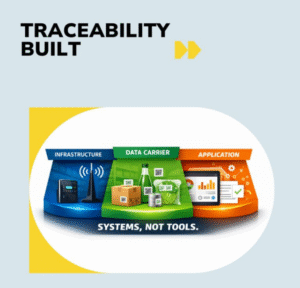
Implementing RFID successfully requires more than selecting hardware.
Businesses need a solution that connects product identification, data capture, operational processes, software integration, and reliable information management.
Altinteg, a technology company specializing in RFID-enabled supply-chain visibility and digital traceability, helps businesses design and implement solutions suited to their operations.
Its approach includes evaluating existing workflows, selecting appropriate identification technologies, designing data-capture infrastructure, and connecting identification events with business information systems.
Through its Traceability as a Service approach, Altinteg focuses on connecting physical products with useful digital information throughout the supply chain.
This is relevant to food manufacturing, distribution, retail, and other industries where reliable product identification and traceability are important.
Start with a free consultation
Companies interested in modernizing their labeling, RFID, or traceability processes can begin with a free initial consultation with Altinteg.
The consultation provides an opportunity to discuss existing operational challenges, identify possible improvements, and explore suitable technology options before committing to a larger implementation project.
Further technical assessment, feasibility studies, and implementation services can be scoped separately where required.
Conclusion

Digital traceability is becoming an increasingly important part of modern manufacturing.
RFID can help manufacturers improve inventory visibility, automate identification, reduce certain manual errors, and retrieve traceability information more efficiently.
However, successful implementation requires a clear understanding of existing processes, accurate data, appropriate technology, and measurable objectives.
European digitalization statistics show that integrated business systems are becoming more widespread, while the development of Digital Product Passports introduces new expectations for product information and interoperability in selected sectors.
For manufacturers, the most practical strategy is to begin with a traceability assessment, identify the processes that would benefit most from automation, and validate the technology through a pilot project.
The future of manufacturing traceability is not simply about replacing paper with software. It is about connecting products, processes, and reliable information to support better decisions.
References and Further Reading