

How Digital Technology Is Transforming Food Transparency?
August 10, 2026
Escherichia coli and Foodborne Diseases — 3 Key Risks
August 25, 2026
Foreign material is one of the most important physical hazards that food manufacturers must control throughout the production process. Metal, glass, wood, plastic, stones, insects, or other unwanted materials can enter food at different stages and may result in consumer injury, product contamination, customer complaints, product withdrawal or recall, and significant damage to a company’s reputation.
Effective foreign material control is not achieved simply by installing a metal detector at the end of a production line. It requires a preventive system that begins with incoming raw materials and continues through processing, storage, packaging, and final product release.
Within the AIB Operational Methods and Personnel Practices category, foreign material prevention is addressed through several interconnected controls, including sieving of bulk dry ingredients, filtration of liquid ingredients, magnets, metal detectors, X-ray systems, and other detection technologies.
The principle is straightforward: foreign material should be prevented, detected, isolated, investigated, and eliminated before it reaches the consumer.
1. Sieving Bulk Dry Ingredients — The First Line of Defense

Bulk dry ingredients such as flour, sugar, starches, powders, spices, and other finely processed materials can contain unwanted particles or insects. For this reason, sieving is an important preventive control before dry bulk materials enter the production process.
According to AIB requirements, bulk dry materials should be sieved before use. Finely ground dry materials require a finer mesh to provide effective removal of unwanted particles, while other bulk dry materials should be sieved using an appropriate mesh size based on the characteristics of the product and the particles that need to be removed.
However, simply having a sieve installed does not guarantee effective control.
The sieving equipment itself must remain in good condition. A damaged mesh, broken screen, or defective component may prevent the system from working effectively and can even become a source of foreign material.
For this reason, screens, filters, and sieving equipment should be inspected regularly for damage, deformation, tears, or other defects. These inspections should be documented so the business can demonstrate that the control is actively implemented rather than simply described in a procedure.
Particular attention should also be given to the material rejected by the sieve.
Daily examination of sieve rejects can provide valuable information about potential problems further upstream. If an unusual foreign object is found, such as a piece of metal, plastic, rubber, or another unexpected material, simply removing it from the process is not enough.
The source needs to be investigated.
For example, if a metal fragment is discovered in sieve rejects, the relevant processing equipment should be inspected to determine whether a worn or damaged component could have generated the material.
This turns sieving from a simple physical barrier into an important process monitoring and root cause analysis tool.
2. Filters and Screens — Protecting Liquid Ingredients

Foreign material control is not limited to dry ingredients. Liquid raw materials and processing additives can also contain unwanted particles, particularly when materials are received in bulk through tankers or closed transfer systems.
For this reason, bulk liquid ingredients should pass through appropriate receiving filters before entering the production process.
The filter mesh size should be selected according to the characteristics of the product and the type of foreign material that needs to be removed. The objective is to provide effective filtration without unnecessarily restricting the product flow or negatively affecting the process.
Again, the presence of a filter alone is not sufficient.
Filters should be cleaned and inspected for integrity after each load. A damaged, incorrectly installed, or blocked filter can become a weak point in the control system and may allow contamination to pass into the production process.
Where filters and screens are part of a CIP system, their integrity should also be verified as part of the cleaning process. This is particularly important when components are installed inside closed systems and cannot be easily inspected during normal operation.
Inspection results should be documented, including the condition of the filter, any foreign material discovered, deviations identified, and corrective actions taken.
If filters are installed on delivery vehicles or portable filtration systems are used, their cleanliness and integrity should be verified before material transfer begins.
This is particularly important during raw material receiving because once contaminated material enters the facility, removing the risk becomes significantly more complicated and costly.
3. Metal Detectors, Magnets, and X-Ray Systems — The Final Barrier
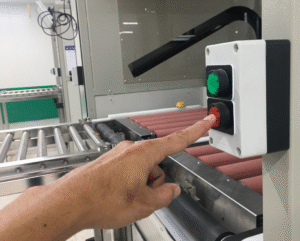
Even with strong preventive controls, it is not always possible to eliminate every potential source of foreign material. This is why food manufacturers use detection systems such as metal detectors, magnets, X-ray equipment, sieves, and filters at appropriate points in the production process.
These devices should be positioned at the latest practical point on the production line so that contamination can be detected as close as possible to the finished product stage.
However, detection equipment is effective only when it is appropriate for the product and process.
Product composition, moisture content, density, packaging materials, temperature, and production technology can all influence detection performance. Therefore, businesses must select and configure detection systems according to the characteristics of the products they manufacture.
Metal detectors and X-ray systems should have appropriate alarm functions and an effective rejection mechanism. When contaminated product is detected, it should be automatically or securely diverted into a controlled and protected area accessible only to authorized personnel.
Rejected product should never simply disappear into a waste container without investigation.
Every unusual detection provides an opportunity to understand what happened.
For example, repeated metal detections may indicate wear or damage to a piece of processing equipment. Repeated plastic fragments may indicate deterioration of a component, packaging material, or processing tool.
Therefore, foreign material detection equipment should not be viewed only as a final safety barrier.
It can also function as an early warning system for equipment deterioration and process failures.
Magnets require similar attention. Where magnets are used, their attraction strength should be tested at an established frequency. Any deviation from manufacturer specifications or internal requirements should be investigated and corrected.
4. Verification, Documentation, and Corrective Action

Installing a foreign material detection device does not automatically mean that the control is effective.
Metal detectors, X-ray systems, magnets, filters, and sieves all require regular inspection, testing, monitoring, and verification.
A food manufacturer should have clearly defined procedures explaining how each device is operated, how frequently it is tested, which test pieces or standards are used, who performs the checks, and what actions must be taken if the equipment fails a test.
All verification results should be documented according HACCP system.
If a metal detector or X-ray system fails its required test, immediate action is necessary. The affected product should be isolated and placed on hold, and the business should determine which products were manufactured since the last acceptable verification.
Depending on the circumstances, affected products may need to be re-screened, re-tested, investigated, or otherwise controlled according to the established corrective action procedure.
Employee training is equally important.
Operators must understand not only how to perform a detector test but also why the test is required and what to do when a deviation occurs. A procedure is only effective when employees understand and consistently apply it.
Every foreign material finding should also trigger an appropriate investigation.
If plastic fragments are repeatedly detected, the business should investigate their source. If metal particles continue to appear, equipment wear should be assessed. If unusual materials are consistently found in sieve rejects, the raw material supplier, receiving process, or upstream equipment may need to be reviewed.
This is where corrective action and root cause analysis become essential.
The objective is not simply to remove the foreign material that has already been detected.
The objective is to prevent the same problem from happening again.
Conclusion

Foreign material control in food manufacturing is not dependent on one piece of equipment. It is a system of interconnected preventive and detection controls.
Sieving bulk dry ingredients, filtering liquid materials, using magnets, metal detectors and X-ray systems, conducting regular inspections, verifying equipment performance, maintaining records, and implementing effective corrective actions all contribute to controlling physical hazards.
However, the most important part of the process is what happens after foreign material is discovered.
Removing the material solves the immediate problem, but identifying its source and eliminating the root cause prevents recurrence.
The AIB approach demonstrates that effective physical hazard control begins with prevention and continues through monitoring, verification, investigation, and continuous improvement.
A safe product is not simply one in which no foreign material was detected. It is a product manufactured through a system designed to minimize the possibility of foreign material entering it in the first place, that protect us from product recall.